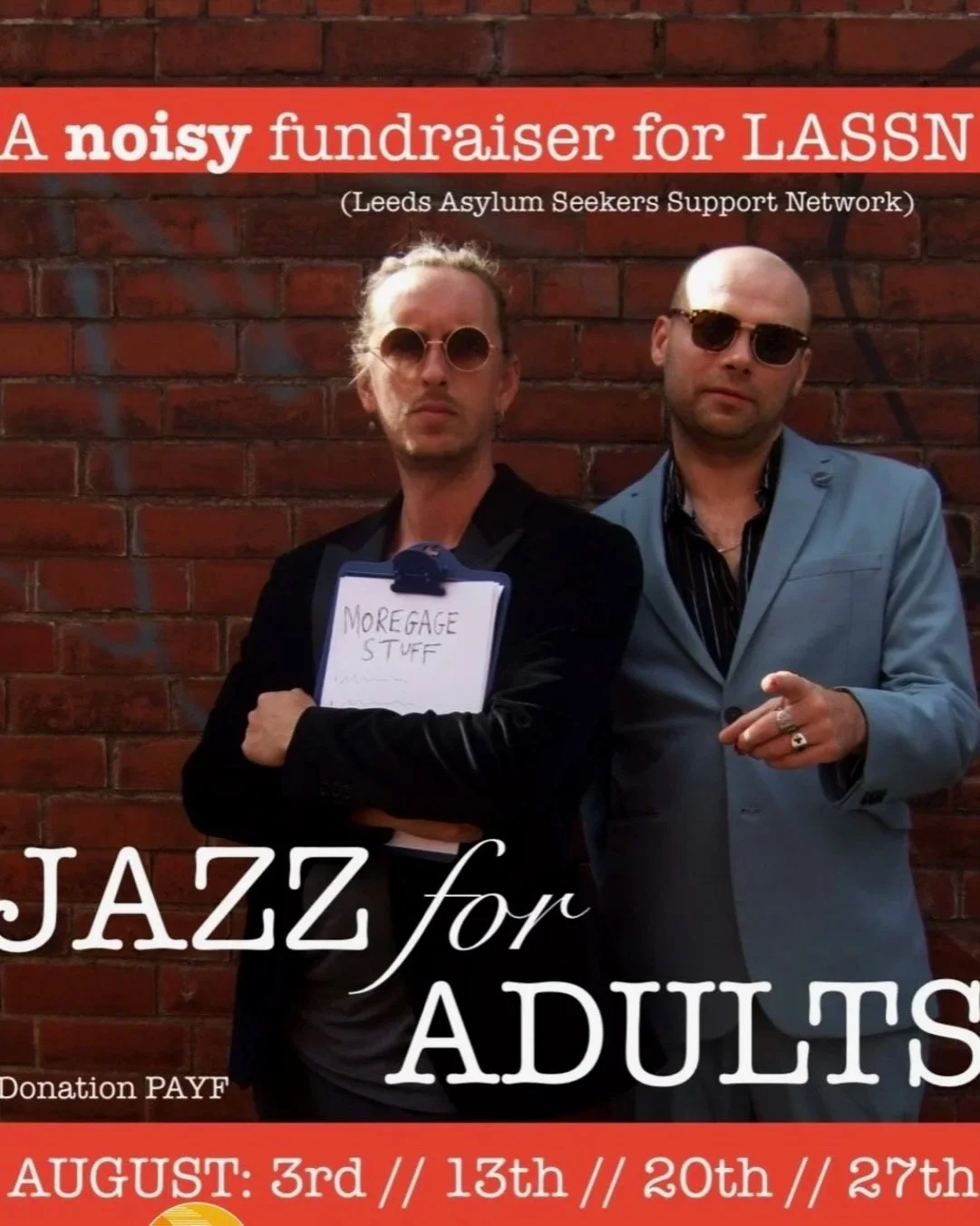
Jazz for adults x lassn
Now that I’m enlightened, I’m just as miserable as ever. Not the kind of existentialism you expect to be experiencing on a Wednesday evening trip to the local.
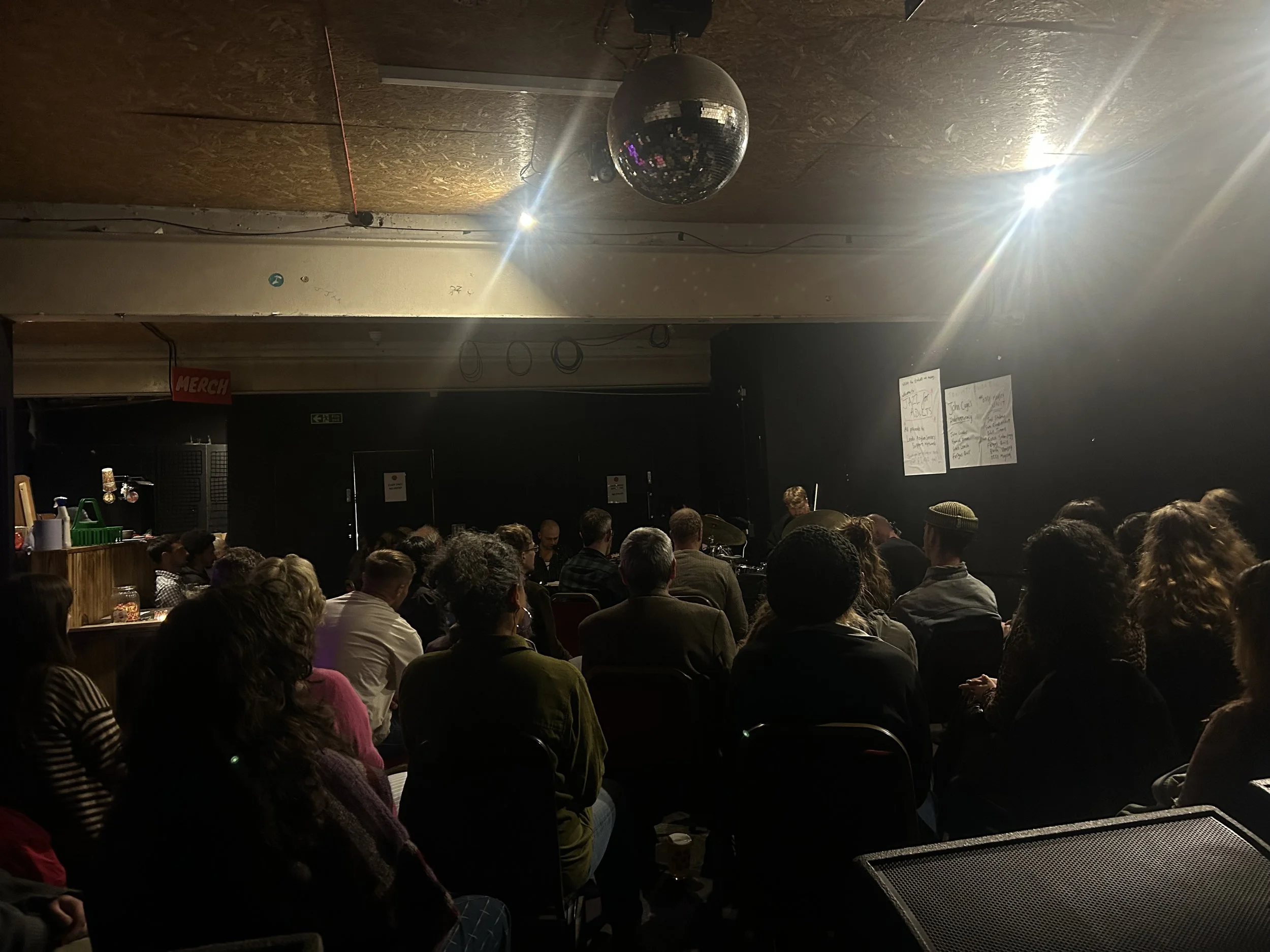
Since moving to Leeds only a few weeks ago, Hyde Park Book Club has become our old faithful. No Otley runners, cheap lager, banging food, and you’ve guessed it, a fair amount of books. We were nestled inside, me trying to write, and Ben, desperately trying to finish Stephen King’s Pet Cemetery with all the strength he could muster. It seemed both tasks required some hoppy comfort. I went to the bar to get another round when I heard talk of an event happening in the basement downstairs; Jazz, you say? I can’t resist a bit of jazz. As a hopeless romantic and budding saxophonist, I could think of nowhere better to spend my Wednesday evening. I enquired if I was late, if it was ticketed, will I have to go back to my glaring computer screen and only dream of the melancholic magic happening beneath my feet? That’s when a charming Irish voice came to the rescue. Pay as you feel, he said, its jazz for adults, raising money for Leeds Asylum Seekers Network, I hope to see you down there.
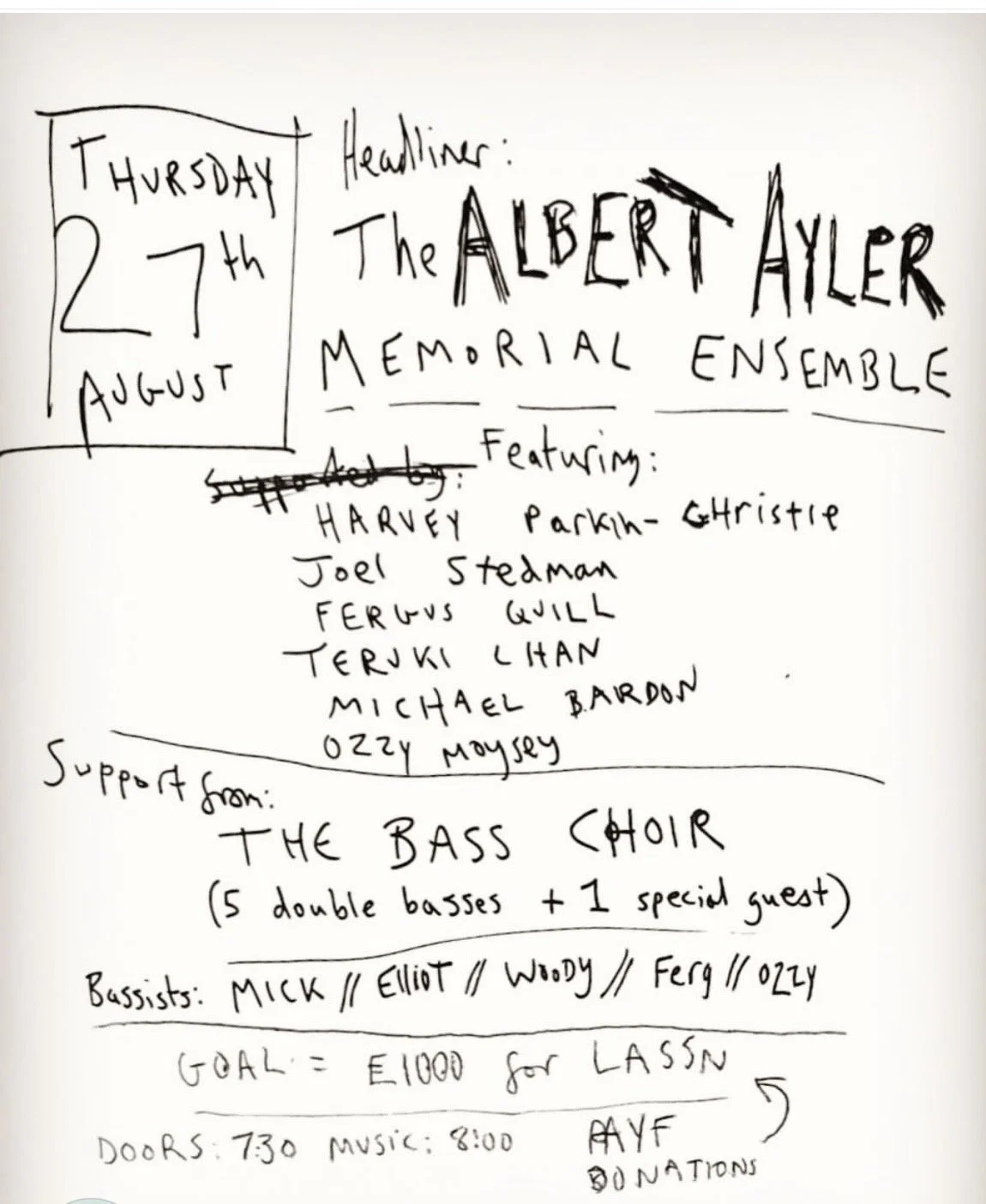
The room was fairly crowded and we ended up sat cross legged on the stage at the back of the room. The first act was a quartet made up of Glenn Leach, John Lodder, Hamish Dixon, and Fergus Quill. A cacophony of undulating rhythms shrouded around Fergus’s unbreakable voice as he read out passages from John Cages ‘Indeterminacy’. For those of you not familiar, (don’t worry, I had to google it too) Indeterminacy in music is a compositional approach in which certain aspects of a work are left open to chance or the interpreter's discretion. At first, the words, keys, and drumbeats seemed to be in battle with one another, every so often one sound dominated the other and there was a brief equilibrium, a stillness, with Fergus’s voice still subtly guiding them . Soon, they would heat up again, writhing around, confusing boundaries between harmony and distortion. It was at first challenging to adjust my ear to the music, the sounds were magnificent, but I couldn’t work them out, apart from Ferg’s voice, there were no structures to ease my senses. After a short while I was entranced, I surrendered to the unknown composition, and realised that what it was my ear could not quite pick up at first were the sounds of freedom, complete liberation of traditional musical score. It fascinated me to think of musical scores this way; as cages that lock away all the potential of sound. I had only been there 20 minutes. it was a Wednesday. ‘Now that I’m enlightened I’m just as miserable as ever’, spoke Fergus. That is exactly how I would describe that Wednesday evening. I felt like a curtain had been lifted on my understanding of music. I had only been there 20 minutes. It was magical. It was powerful.
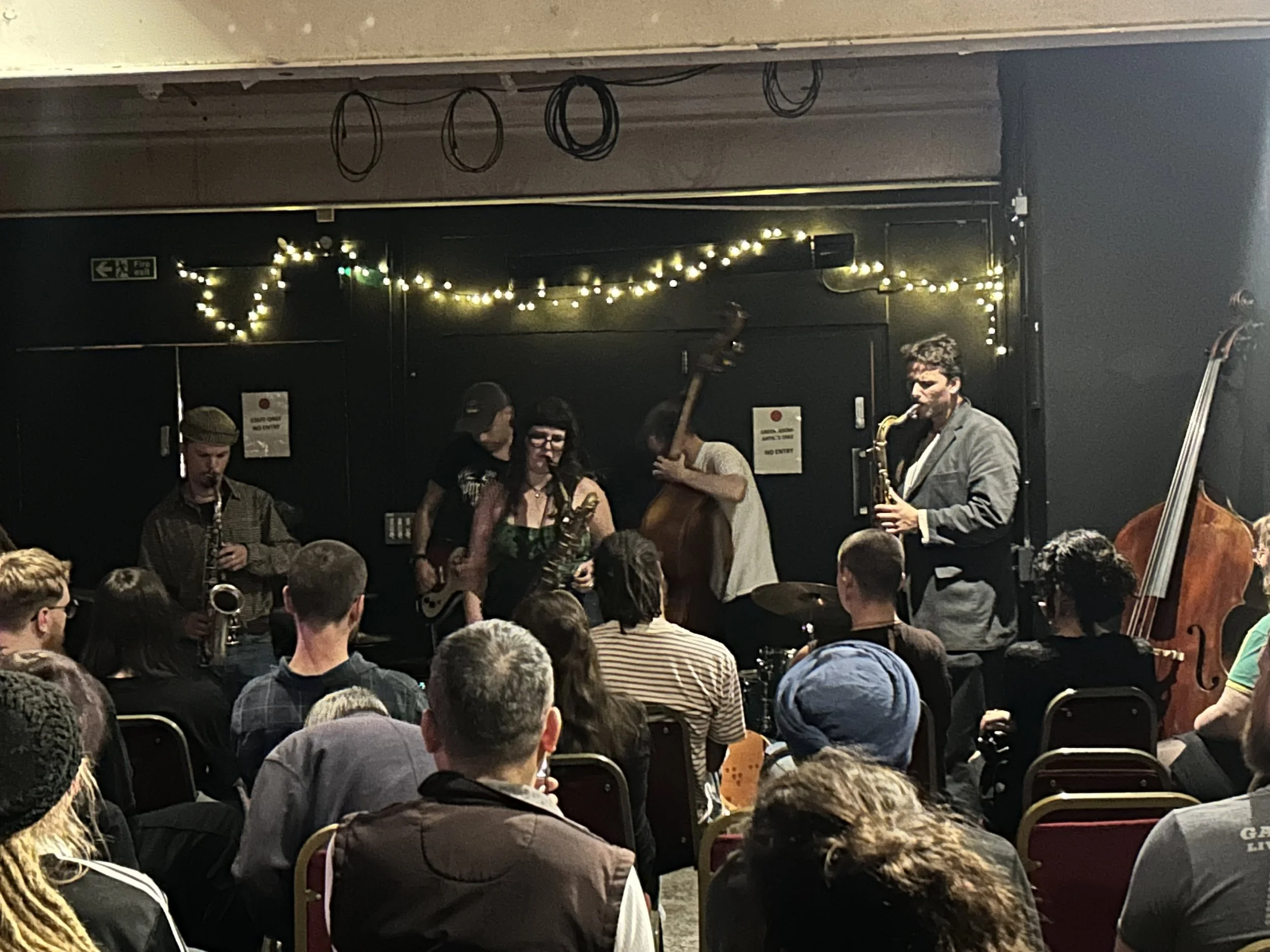
The second act; The Ozzy Moysey Unit. A much larger body of musicians playing music written by Ozzy himself. I could sense a theme throughout the evening. Liberation. A song titled, ‘Iran’ was played early on in the set, which saw a vast array of instruments find solace and solidarity in the winding, bending, koron inspired notes of the piece, collecting the hearts of the audience in its undulating path, replacing them with hope and passion.
The band finished on a song with no title. And with no title I hope it remains. No written words could even begin to capture the essence of the collective sounds that diffused into the souls of the audience, engineering their emotions, brain chemistry, the body itself. I know I can’t speak for everyone, but that’s how I felt, anyway. Ozzy, who had been playing the snare drum all evening, rose from behind his instrument. The scene was almost biblical. Each performer seemed to supernaturally gaze in his direction, the figure risen from the rest of the band, arms outstretched, as if releasing his heart and soul to the room. His arms began to move along with the music, it was unclear who was guiding who, like there was an unbreakable connection, a bond created by these sounds. It seemed as if each instrument knew how to play to Ozzy’s body, soul, mind. The score was not written how you would imagine and it did not come from a way of reading, but a way of knowing, a way of trusting, and a way of believing in the freedom of sound.
I asked Ozzy if I could chat to him about not only his mind-bending work and talent, but the amazing charity he is donating the proceedings to - Leeds Asylum Seekers Support Network. LASSN are a fabulous charity made up of 149 volunteers who support asylum seekers with emergency financial support, language lessons, support with isolation, and mental health. With the help of donations, LASSN ensure that asylum seekers in Leeds are part of a valued community and have the opportunity to experience freedom and liberation in a society that more often than not seems closed off by strict, seemingly unbreakable values and beliefs. The keywords here are freedom and liberation. They are concepts that Ozzy and Fergus experiment with in their compositions, testing the limits of what their audiences understand and feel towards liberation and how far they will actually let their senses break free from invisible chains to find solidarity and community amongst the unknown and alien. LASSN work tirelessly against the political backdrop of this country to provide freedom and liberation to those who have fled oppression in search of freedom. The work of both Jazz for Adults and LASSN are mutually reinforcing, not only because a jazz night is a perfect way to raise money for charity, but also because they allow us to reimagine and believe in freedom.
I met with Ozzy and Ferg a week later. The afternoon of their penultimate performance with Jazz for Adults. It was my first time interviewing people I did not know, I was quite nervous. Besides the both of them, and their friend Bess, being perhaps the loveliest people, I have ever had the pleasure of talking too, the conversation itself is one that I will cherish forever.
It was a rainy Thursday afternoon, still warm outside, people were caught off guard huddling together in the entrances of pubs and cafes. I was running from my work to Book Club through the park. It is no more than a 10-minute walk, but the unsuspecting hilliness of LS6 toys with your idea of time, especially when you are in a rush to get somewhere. I arrived and found Ozzy, Ferg, and some of their friends in a corner of the Book Club known as the snug, jammed in next to an old wooden upright piano, rolling cigarettes over coffee. What a glorious way to spend a Thursday afternoon. I made sure to take off my work lanyard. It would have ruined the idyll bohemian enclave I had burst into, sodden and damp. We went outside to a table under shelter and the conversation began. I wanted to know more about Jazz for Adults, why they started this group, who their fellow bandmates are, and their relationship to LASSN . I started the conversation like this because that is what I had planned, what I structured for myself, but I soon realised that what I really wanted to know was yet to be revealed to me in the natural course of the conversation. The answers I wanted came from improvisation, not pre-planned ideas of what questions you should and shouldn’t ask in an interview.
To get us warmed up, Ozzy told me a bit about the Jazz for Adults gigs at Book Club; Ozzy and Ferg quite simply love live events, community spirit, and shared passion, but to put it quite aptly in the words of Ferg himself, it is an excuse to put on music they like. And you simply cannot argue with that. It is this honesty that I found quite inspiring. They have such an intense shared love of music, why shouldn’t they put on a show. For those of you wondering where the Jazz for Kids groups have been hiding, Ozzy explained that Jazz for Adults is in response to the students leaving Leeds in the summer. Hyde Park Book Club, when the students are roaming about, is home to Hyde Park Jazz Club. This event stops at the beginning of summer, leaving LS6 jazzless and longing for some deep blue soul over the summer months. Ozzy and Ferg wanted to encourage every man and his dog to lose themselves in the mind-bending, soul destroying, heart soaring insanity of their incredible conductions and the music of others they chose to celebrate.
I asked the two of them about their music practice, how they got started, and how they continue to defy the boundaries of what we understand music to be. They are both honorary adoptive Leeds folk, coming here to study at Leeds College of Music. Although they did not know each other during their time there, they soon found each other and had similar experiences, struggles, and passions to share. They left college armed with knowledge of musical scores and skills of notation and found freedom in unravelling them, rewriting them, and making them their own. As students with little money, the pair often explored their passion for music by improvising, creating sounds of their own free will without being constrained by the expectation of their instruments. Through improvising, Ozzy and Ferg established their own musical philosophy that is carried through their Jazz for Adults ensembles; getting to know their fellow musicians through sound and feeling, playing with them rather than their instruments. Improvisation for Ozzy and Ferg is an act of solidarity and community, where musicians respond to each other’s expressions to create a distinct language of mutual understanding that can be shared with those listening, not just playing. We get to know the person, not just their instrument.
The more I spoke to Ozzy and Ferg the more my own relationship to music started to transform. As someone who has been playing the piano since a very young age and can read music and can get on slightly with a bit of theory, I still feel quite intimidated by it. I have always played but never done grades and feel like a failure if I can’t quite get the rhythm right when following along to my Mary Poppins sheet music. I have always had a deep love for music. It is the only thing that truly moves my soul. Yet, I feel like an imposter for not having a wealth of musical knowledge. Ferg had a remarkable response to my whinging. The word he seemed to focus on was dogma - meaning mainstream music and musical education in the modern age is dogmatic. It demands a right and wrong way of being heard, felt, and played. It is monetised, placing worth on the right notes and destitution on the wrong ones; there is no room to explore, improvise, or find your own voice. The flexibility of music is not taught to us. Ferg explained how nothing in music is new, it is a constant recycling of the same progressions, chords, instruments; what changes is the person creating those sounds, how they are making those sounds, and what expressions they are imposing upon their instruments. This flexibility can only be truly achieved through improvisation, a fundamental element to Ozzy and Ferg’s practice and also a key movement within musical history that is often written out of Western discourse. Improvisation is an unfathomable language that connects us universally - where the conversations we have with each other through sound are based on chance and fate; where you are the leader of your own expression - ‘judgement ends with the individual’, as Ferg would say. Ferg likened today’s dogmatic scores to generational trauma. We kill ourselves trying to learn the concertos of the greats, but what we don’t realise is that they are not their true authentic concertos at all, merely interpretations of their music, written down centuries after their death. It is modern history’s attempt to cling on to imperial, grandiose histories instead of making room for the voices of our own time; voices that unite cultures across the world, instead of forging an inaccessible western canon composed of a series of dots and lines.
Ozzy showed me his own relationship to Conduction (different to conducting - it a specific method that merges real-time composition with conducting, like sculpture, allowing an ensemble to improvise collectively within the structure of a specific piece.) I was in complete awe. Ozzy uses ancient, spiritual symbols, like hieroglyphics, to encapsulate a certain feeling or expression. Take a wick, for example, like you would find on a candle or a stick of dynamite. You could interpret this symbol as a gradual ascension of an almighty sound, or the gentle descension of a collective sound. Ozzy presents his scores to the ensemble, where they are each free to interpret the music in their own way so he can hear the musician above their instrument and carry the music through a shared understanding of that particular moment. Other symbols include the cobra, owl, reed, for example. Each one fusing the personal with the instrumental and allowing for interpretation within the rules of musical score. Where emotion is given the freedom to form a vocabulary, a deeply human one ,that has no academic structure. Where musicians are so much more than pawns bound to someone else’s rhythm.
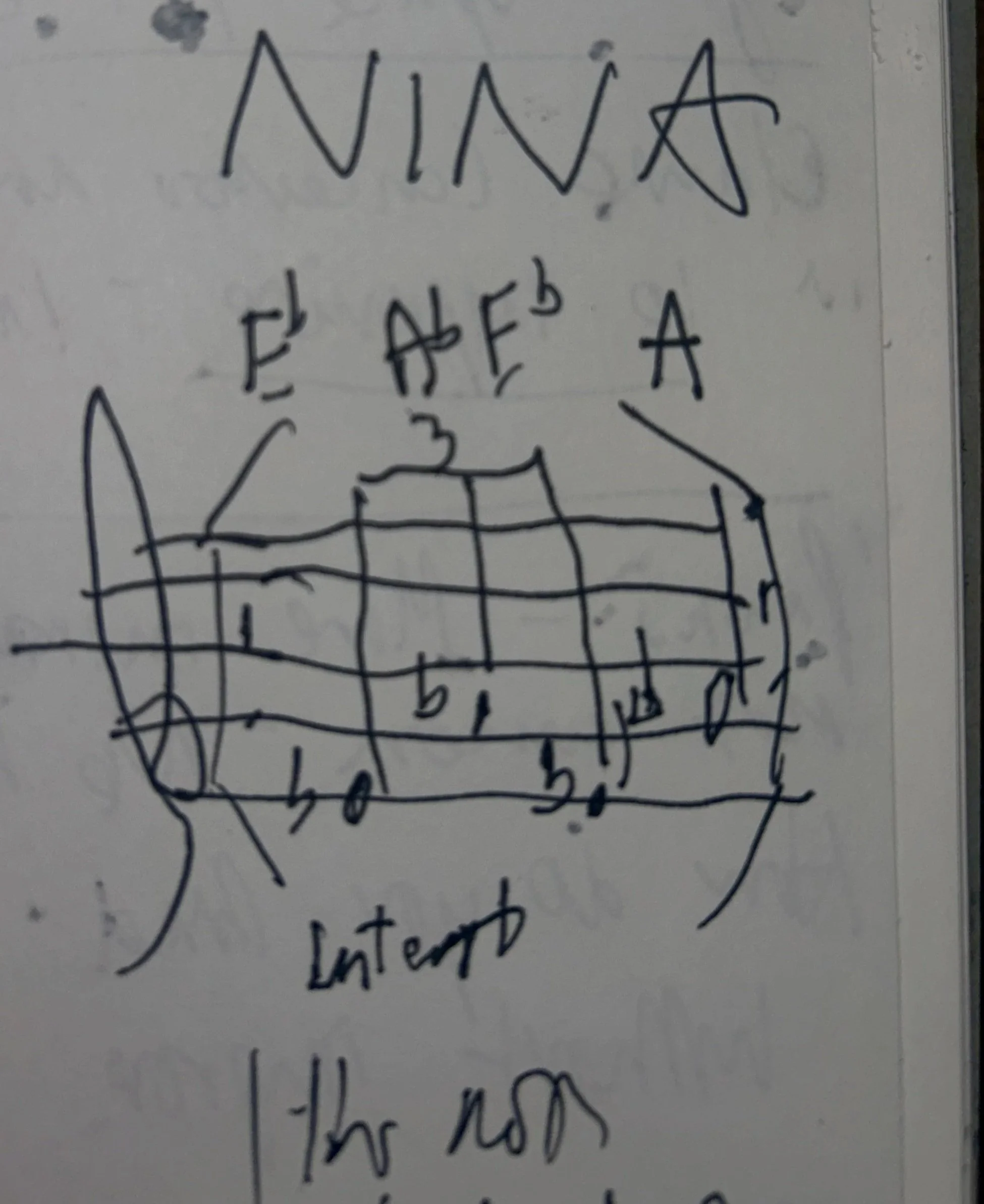
Music can also exist immediately, in the moment, without any prior framework. Ferg asked me to write my name in my notebook. I sat and behold my name in capitals, ‘NINA’, being transformed into a riff. I stared at the four letters I had existed within my entire life, but Ferg saw something different. He first observed the ‘A’ (an obvious contender for an A chord). Next, the ‘I’, which finds its home in a series of vowels, ‘A’ being a part of that family, so an ‘A’ it was, but not quite, so an A flat was decided. Finally, the ‘N’, more complex you would think. But Ferg squinted his eyes and played around with the collection of lines to extract an E, but again, not quite, so an E flat we did have. He wrote these notes within a make-shift score and began experimenting with the limits of their sound, first by grounding the pitch with his voice, before introducing the elemental instruments of a water bottle and a vape. I watched Ferg and Ozzy converse over these sounds, bartering back and forth between the rhythmic bangs of the vape hitting the wooden table with musical expression. I watched my name become liberated from its dogmatic nature to a site of musical opportunity.
It wouldn’t be A Room Up North without a brief celebration of what the north has to offer any creative or inquisitive mind. As I have previously mentioned, Ozzy and Ferg both arrived to Leeds as students but have certainly made their mark on the northern cultural landscape. I asked them about their experiences with opportunity up here and how they managed to balance rent, work, and creativity. Like I have said, we were joined by their friend Bess, a fellow musician, who can truly tear up a flute and get you right in the gut with a saxophone. Bess used to live in Leeds before moving to London, (booooo! I hear you shout with northern grit). It is true, there are a lot more opportunities in London: more venues, more people to network with, and more chance of ‘making it’. But Bess painted an alternative and massively overlooked picture of the difference between the north and the south in terms of opportunity. Her first response to my question was that since moving to London, her piano skills have dwindled. Although not a classically trained pianist, as a musician it is something she experiments with and finds joy in exploring. She said that in Leeds, everyone seems to have a piano (this is strangely quite true). When going to friends’ houses, or even friends of friend’s houses, there was always a piano waiting to be the explored. In the same act of seeing friends and socialising, it was common for Bess to be conversing through music or bonding over a shared intrigue at what the piano had to offer. In London, however, the vast distance between people’s houses means that most social events happen in the centre, at a pub or bar. The cost of living and pitiful size of most flats mean pianos are hard to come by in domestic settings, and it is rare you will find one in a pub in central London. The North is peppered with unexpected opportunities - opportunities that often arise from community and friendship, that don’t come in the form of flashing lights, but in camaraderie and pure pleasure. Ozzy commented on his early days in Leeds and the opportunity he had to spend much more time on his practice compared to what would be possible in London. His fairly cheap rent meant he could work a reasonable amount of hours and spend the rest on his practice, whilst having time to get out and explore things that were going on in the city, instead of having to work every passing minute to be able to afford rent.
It is difficult to completely sum up my experience at Jazz for Adults and my conversation with Ozzy and Ferg in this article because most of it existed as feeling, something that far exceeds the distribution of facts. I hope that I have given you at least a slight insight into this incredible world of musical freedom that happens in the most inconspicuous of places. I hope it makes you second guess who you are rubbing shoulders with in your own local or any cafe you may find yourself in on a Thursday afternoon.
So, please, get yourself to your local, social club, café, anywhere that houses your fellow northerners and see some of the incredible things they do to make our community thrive and change the world with passion, creativity, and solidarity.